
Olalla
Robert Louis Stevenson’s haunting tale of a bloodthirsty family in war-torn Spain interrogates the erotic power and mortal terror of the vampire myth

Didn’t Hammer Horror drain the sex out of vampires? There’s nothing quite like a grey-faced man in a shiny cape with a widow’s peak to quell any urges you may be having to bare your décolletage. I grew up thinking Dracula must be a bit of a hammy, gory comedy; that vampires were joyously camp characters, trembling before garlic, beloved of children on Halloween. Toothless, ironically.
It wasn’t until I acted in a school production of Liz Lochhead’s Dracula when I was sixteen – I had a fucking fabulous drama teacher – that I became aware of the heightened eroticism of the vampire figure. It was my awakening, if you like; the teeth in my own neck. Liz Lochhead’s Dracula is a phenomenal, mesmerising adaptation of the novel, distilling all the gorgeous, blood drenched, petal scattered death and beauty of the book into a potent, concentrated drama. It is soaked in sex from start to finish, balancing the vulgar against the poetic exquisitely. I was playing Lucy (but of course I was) and I could barely believe I was being allowed to speak such words – in our school assembly hall, no less. I’m only just beginning to realise how lucky I was to have a teacher open-minded enough to trust that teenagers were able to cope and engage with text that invoked complex eroticism on that level. (So much better than pretending sex doesn’t exist while simultaneously turning a blind eye to the whole class watching choke-porn on their phones.)
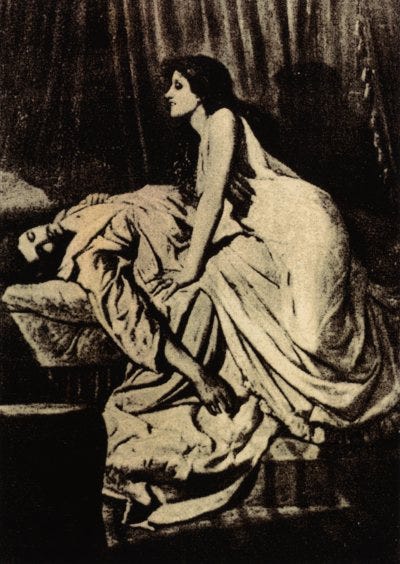
Vampires are the trojan horses of erotic storytelling then, for I’m fairly sure if it were not for the cuddly Hammer Horror Draculas that dominated the genre, my drama teacher may not have got that school play past the in-house pearl-clutchers. (Nor indeed would Bram Stoker or Robert Louis Stevenson in the late 19th century have had their works pass uncensored).
I think the appeal of vampires goes beyond the thrill of physical intimacy and danger, of having your neck bitten and blood sucked. There is of course the notion of ultimate possession – of the vampire taking the blood, the life force of another being into their body. But there are also all the motifs of somnambulism and trance; half-sleep, liminal states; passivity and surrender; the reminder of our own mortality reflected against the vampire’s immortal power; the reminder of our fragile humanity in the decision we make as to whether to succumb to the magnetic pull of the vampire, or to resist.
It’s the terror of the power of lust and desire that really comes through in Stevenson’s Olalla. Olalla is somewhere between a short story and a novella (it was first published in a Victorian magazine, but it’s about 50 pages), and was written only a year before his most famous masterpiece The Strange Case of Dr Jekyll and Mr Hyde. (I say his most famous masterpiece, I’m actually Team Olalla when it comes to my favourite Stevenson, not because I have rigorously judged the literary merits of each, I simply felt Olalla more, and it stayed with me). The overlap of themes between Jekyll & Hyde and Olalla feels very clear, so much so that whole paragraphs of Olalla, especially when Stevenson gets started on the theme of beast versus human, could slot neatly into Jekyll & Hyde. In Olalla the terrifying ‘other’ that lies dormant inside us is the vampire-beast, and it comes in the form of a Spanish family whose wild, appetite-driven habits have caused their lineage to decline, while they continue to cling onto their crumbling clifftop manor house. The daughter of this household – the title character – is every bit as alluring, sensual and gothic as you want your vampires to be; although as we will see, Stevenson’s brilliant and beautiful introduction of his narrator-protagonist to her is anything but clichéd or hammy.
The narrator is an unnamed wounded Scottish soldier. I know the unnamed narrator is a common enough trope, but here the themes of identity and selfhood are so strong it feels like a deliberate decision of Stevenson’s to have this fundamental element of blankness, of empty space, in his lead character. We know the narrator’s nationality, that he has fought in a war, and that he is weak and injured, though we know not how. The doctor he is with at the beginning sets him up with a period of convalescence in the home of an ancient family for whom ‘poverty forces them to unfasten their door to a guest.’
The doctor convinces the soldier that the ‘air of these mountains will renew your blood’, but tells him the family are all so raving mad and degenerate that he must have as little to do with them as possible. After travelling through the wild mountains in a journey that parallels Jonathan Harker’s first voyage in Dracula, he alights at the ‘residencia’ alongside the son of the family, Felipe, a ‘lad’ of ambiguous age, and an indeterminate mental disability that Stevenson’s narrator describes with all the charm and empathy one would expect of a Victorian male writer.
At the residencia our soldier shares his lodgings not only with Felipe, his mother, and his unseen sister, Olalla, but with a myriad of family portraits, all depicting the same uncanny features, echoed with strange and disturbing discord in the current generation. One in particular holds his gaze; a red-haired woman who possesses the very gothic quality of straddling the void between life and death.
‘To judge by her costume and the mellow unity which reigned over the canvas, she had long been dead; to judge by the vivacity of the attitude, the eyes and the features, I might have been beholding in a mirror the image of life.’
He becomes unhealthily fixated on this portrait, and yet is self-aware enough to understand the irrationality of its power.
‘…while I knew that to love such a woman were to sign and seal one's own sentence of degeneration, I still knew that, if she were alive, I should love her. Day after day the double knowledge of her wickedness and of my weakness grew clearer.’
His lust for the portrait begins therefore to suck the life from him, to possess him. But Stevenson never – and this counts for the whole of the story – goes far enough to imply that it is the object itself which holds the power; rather the narrator’s response to the object is where the terrifying loss of control resides.
In directing the focus onto the psychological experience of the narrator rather than concrete physical or supernatural happenings, Stevenson leaves space for his metaphors to percolate. We are left thinking of both lust’s terrifying grip, and of the duality of good and evil, refined and savage in us all. The narrator’s feelings and his actions come from within him, though they may be triggered by outside forces.
This captivating phantom woman is juxtaposed against the all too visceral form of the residencia’s matriarch. Felipe and Olalla’s mother is an animalistic presence, usually to be found outside in the courtyard, sensual and slothful, always lazing around in the sun (an inversion of the usual vampire trope), unsettling the narrator with her languor and her appetite.
Nature itself is in on the act too, whipping up howling storms with an ‘irrational, unchanging fury’, accompanied by ‘a far-off wailing, infinitely grievous to hear.’ Dust cakes the residencia, and the force of the wind stops the narrator from escaping for respite into the hills he has been so promised will be good for his health.
The story meanders and riffs on these discomfiting sights and sounds for a good twenty or so pages, and while very little happens, the teetering of the narrator’s sanity, the lavish melodrama of his feelings towards the strange painting, and the myriad ways Stevenson finds to describe the uncanniness of the residencia give the story an irresistible pull. Violence is never far away. At one point the narrator is horrified to find Felipe torturing a squirrel, and yet within minutes he finds it within himself to retaliate, in the guise of teaching Felipe a lesson.
‘…”Give me your hand in mine. You cannot remove it. Now suppose that I were cruel like you, and took a pleasure in pain. I only tighten my hold, and see how you suffer.” He screamed aloud, his face stricken ashy and dotted with needle points of sweat; and when I set him free, he fell to the earth and nursed his hand and moaned over it like a baby.’
These cascading acts of cruelty are followed by the narrator telling us, ‘Meanwhile I gained rapidly in health.’ Once again Stevenson teases the idea of the vampiric monster inside us all. Has the narrator ‘gained’ through his torture of the weak-minded Felipe, in the same way that Felipe has gained from enacting his bloodlust on the weak squirrel? Stevenson doesn’t want to tell us, though he plants the seed.
But then comes the entry of Olalla, or rather the narrator’s entry into the world of Olalla. And this takes place in what turns out to be Olalla’s library and study. I have to say, I missed the significance of this the first time I read the story but the second time I was left breathless by its erotic symbolism. Wandering the corridors of the residencia, the narrator eventually stumbles upon a chamber (but of course he does, gothic manors contain nothing so pedestrian as ‘rooms’) full of ‘books which lay here and there in some confusion.’ Not just the books – which are a mixture, some old, some devotional, some in Latin – but the way they have been used seems to be an indication of the personality or mental state of their owner: ‘Some I could see to bear the marks of constant study; others had been torn across and tossed aside as if in petulance or disapproval.’ He finds lines of poetry written in Spanish and reads them, and then is immediately seized by ‘shame and confusion’ for his invasion.
The narrator has entered Olalla through her mind, through her words, before he even sets eyes on her. In contrast to the bloody, savage, sense-driven way in which he interacts with Felipe and the mother, when it comes to Olalla, his refined, intellectual, civilised and soulful side becomes dominant, even to the extent that he is self-conscious of his invasion into her private thought space. The image couldn’t be further from the carnal physicality we associate with vampirism, and yet Stevenson succeeds in painting into that idea of entry - of possession - the most cerebral, metaphysical parallel of entry into another person’s mind. I think it’s gorgeous.
Stevenson’s wife, Fanny Van de Grift Osbourne, to whom he had been married for about five years when Olalla was published, was already a notable writer when they first met, and I can’t help but read into this scene a parallel with his own desire and love for her. Maybe that is just fancy. But I love that in an age where a woman’s currency was her physical appearance – so glad that’s all consigned to the past. Phew – Stevenson chose to bring us to the narrator’s erotic desire for Olalla through her intellect and her passion. Possession, entry into another being, does not necessarily have to be physical. (I mean, he does then go on a rampage about how beautiful she is, but the point is it was her brain he fell for first, and that is hot).
It's probably not a spoiler to say that things don’t end happily ever after between Olalla and the soldier. For starters there is the small matter of Olalla’s mother’s beastly appetite to contend with. (In the most explicit moment of vampirism in the story she bites the soldier’s wrist to the bone and sucks his blood). But more powerfully tragic is Olalla’s obsession with the idea that she will inherit the diabolical characteristics of her lineage – it’s this that makes her push the soldier away in the end. Vampirism stands for the fear we all have of our personalities being threaded through with genetic material we cannot control. We cannot control who we are, nor can we control who we desire. That’s the real terror of the vampire – as well as the thrill.
*
For more reading on Olalla there is a brilliant essay here at The Bottle Imp, which talks a bit about the homoerotic relationship between Felipe and the narrator, and locates the story more clearly in the vampire tradition.
And if you’re in Edinburgh on Valentines Day please come along and say hello at the launch of Unspeakable Shaking Pleasures, hosted by Lighthouse Books.